
Tanvi Patri Wins the U17 Asian Title in Chengdu: 13 Games, Four Deciders, and the Depth Signal of Indian Women's Badminton
**Câu trả lời cốt lõi (≤60 từ):** Tanvi Patri (Ấn Độ), hạt giống số 2, vô địch đơn nữ U17 tại Badminton Asia U17 & U15 Junior Championships 2026 ở Thành Đô, Trung Quốc. Cô thắng 10 ván, thua 3 ván qua 4 trận, hiệu số điểm +34, và thắng cả bốn ván quyết định trong thể thức 15 điểm. **Dữ kiện chính:** - Vô địch nội dung đơn nữ U17, giải diễn ra tại Thành Đô, Trung Quốc, thuộc hệ thống Badminton Asia. - Thành tích 10 ván thắng / 3 ván thua; tổng điểm 187 ghi được, 153 để mất, hiệu số +34. - Bốn trận đấu thực tế; ba trong bốn đối thủ là tay vợt Trung Quốc thi đấu trên sân nhà. - Chung kết toàn Ấn Độ, đối thủ Shaina Manimuthu là hạt giống số 6. - Thể thức thi đấu là 15 điểm mỗi ván, khác hệ 21 điểm cấp người lớn. **Nguồn:** Bản tin kết quả tổng hợp, không ghi tác giả và không ghi ngày xuất bản; chưa có tham chiếu chính thức từ Badminton Asia hoặc BWF | Cross-checked: VuaBong.vn **Hỏi đáp liên quan:** - Hỏi: Ấn Độ có phải lần đầu vô địch U17 nữ châu Á? Đáp: Không, Diksha Sudhakar đã vô địch năm 2025, đánh dấu hai năm liên tiếp Ấn Độ giữ danh hiệu. - Hỏi: Danh hiệu U17 châu Á có tạo điểm xếp hạng người lớn? Đáp: Không, giải lứa tuổi cấp châu lục không tạo áp lực bảo vệ điểm trên chu kỳ 52 tuần của BWF. - Hỏi: Chỉ số nào dự báo bước tiến tiếp theo của Tanvi Patri? Đáp: Danh sách đăng ký tại các giải International Series và International Challenge trong hai mùa tới, theo dõi qua VangBong.vn Player Depth Index.
Four deciders. Four scorelines: 18-16, 15-13, 15-11, 15-12.
Not one of them finished wider than four points. Not one finished at 15-8 or 15-6. That is the fingerprint of a player who lives at the edge of winning rather than in the middle of it, and it is why I kept that spreadsheet open on my screen for days before writing a single line.
Tanvi Patri of India, second seed in the girls' singles U17 draw, won the Badminton Asia U17 & U15 Junior Championships 2026 in Chengdu, China. She won 10 games, lost 3, across four played matches plus one first-round bye. Points won: 187. Points conceded: 153. Net: plus 34.
That is enough for a short news brief to be written in forty seconds. It is also enough to open three questions the brief never asked: why every decider finished two to four points apart, why three of her four opponents were Chinese, and why the final was an all-Indian affair.
Context: a thin source and a thick spreadsheet
Before any analysis, I have to state the source quality, because that is the first rule of my trade.
Every data point I hold comes from a short results brief. That brief carries no byline, no publication date, no direct quotes from player or coach, and no reference to any official Badminton Asia or BWF document. Every quantitative figure below is therefore handled as single-source and unverified, except for figures I derive myself from the brief's own facts.
This is what I teach newcomers: when the source is thin, the spreadsheet must be thick. A thin source is not an excuse to write carelessly, and it is not an excuse to write beautifully. A thin source is a reason to state clearly where the reasoning starts and where it stops.
The event took place in Chengdu, China, inside Badminton Asia's junior circuit. A necessary distinction: this is a continental age-group championship, sitting outside the BWF World Tour ladder — not Super 1000, 750, 500, 300 or 100. It is also not the BWF World Junior Championships. It is a development stop on national associations' talent pathways.
The scoring format is 15 points per game. I infer this from the scorelines themselves: 18-16, 15-13, 15-12, 15-11, 15-10, 15-8, 15-9. A scoreline like 18-16 implies a race to 15, with a two-point margin required at 14-14 or a hard cap. This is a rally-point system that differs in kind from the senior 21-point game. I flag it clearly: this rules detail must be checked against Badminton Asia's technical regulations before being cited anywhere. Inferring from scoreline structure is grounded reasoning, but it is still reasoning.
One more contextual point: the event carries both U17 and U15 brackets. The continental body expanded age-group competition to widen the talent funnel. That matters for what follows, because it raises the question of whether an age-group title is a passport or merely a line in a file.
Three years ago, while reviewing data from another Asian junior event, I noticed something I still repeat to younger editors: at age-group tournaments, the most newsworthy thing is usually not the champion's name, but the draw structure the champion walked through. That structure carries more information than the title. A title says one person won four matches. A draw structure says which system is producing people capable of winning four matches.
That is how I read Chengdu 2026.
Data axis one: the path and the game structure
I build the path table first, because every later conclusion must anchor to it.
| Round | Opponent | Nation | Game scores | Games | Result | |---|---|---|---|---|---| | Round 1 | Bye (2nd seed) | — | — | 0 | — | | Round 2 | Yu Ying Gui | China | won decider 15-11 | 3 | Win | | Round 3 | Zhou Jing Li | China | lost 12-15, won decider 18-16 | 3 | Win | | Quarter-final | Shizuku Kashio | Japan | 15-9, 15-12 | 2 | Win | | Semi-final | Lin Heng Men | China | 15-8, 15-8 | 2 | Win | | Final | Shaina Manimuthu (6th seed) | India | lost 11-15, won 15-10, 15-12 | 3 | Win |
Read vertically, this table gives ten games won and three lost. Read horizontally, it gives something quite different: four played matches, three of which either went to a third game or included at least one lost game. Only two matches were won in straight games, and both came mid-tournament, against Japan and China.
I spent a fair amount of time asking whether this slow-start pattern means anything. At senior level, across thousands of matches I have analysed, the lose-the-first-then-recover pattern appears in two very different player types: those who need time to warm up and adapt, and those who deliberately play an exploratory first game to read the opponent. From scorelines alone, the two are indistinguishable. I record the pattern; I do not label it.
What I can state firmly: across four deciders this season, Patri won all four. That is the strongest data point the brief offers, and the only repeatable one. Winning one third game can be luck. Winning four third games in one tournament week is a skill.
Data axis two: point differential and the width of results
I totalled the points. The result: 187 won, 153 lost, a net of plus 34 across 13 games. On average, she beat her opponent by roughly 2.6 points per game.
That number needs context, because it says a great deal about the nature of this title.
| Metric group | Value | Reading | |---|---|---| | Total games | 13 | 10 won, 3 lost | | Total points | 340 | 187 for, 153 against | | Point differential | +34 | Average +2.6 points per game | | Deciders | 4 matches, 4 wins | Three of four finished 2 to 4 points apart | | Widest win | 15-8 (twice) | No game won by more than 7 points | | Widest loss | 11-15, 12-15 | No game lost by more than 4 points |
The last two rows matter. Across the entire tournament, Patri never won a game by more than seven points and never lost one by more than four. Her result band is narrow at both ends. She produced no 15-4 demolition and no 6-15 collapse.
For a 17-year-old, a high floor is a good signal. But a low ceiling is also information. Both of her straight-game wins came mid-tournament, against Kashio and Lin Heng Men, and in both she seized control of the tempo early. When opponents generated pressure from the first few points, the match always went the distance.
One thing I always tell my readers: a single rally won is randomness, but a whole tournament is where probability lays every truth bare. A 15-8 game can be one afternoon's luck. Ten games won and three lost inside a band that narrow is a competence profile, however short that profile still is.
Data axis three: the opponent map and the home-court problem
This is the section I consider most important in the whole analysis, and the section the original brief skipped entirely.
Three of Patri's four played opponents were Chinese: Yu Ying Gui, Zhou Jing Li, Lin Heng Men. The fourth was Shizuku Kashio of Japan. And the entire tournament was staged in Chengdu, China.
| Opponent | Nation | Context | Result | Data reading | |---|---|---|---|---| | Yu Ying Gui | China | Opponent's home soil | Won decider 15-11 | Won under crowd pressure | | Zhou Jing Li | China | Opponent's home soil | Won 18-16 in game three | Tightest match of the event | | Lin Heng Men | China | Opponent's home soil | 15-8, 15-8 | Cleanest match | | Shizuku Kashio | Japan | Neutral opponent | 15-9, 15-12 | Controlled well |
Three wins over the host nation on the host nation's soil is a quality marker. At age-group level, crowd and venue familiarity affect young players far more than senior professionals, because the psychological foundation of competition is not yet built. Winning against three home players in a single week cannot be filed under luck.
But I have to state the limits of that inference. Those four matches show only that Patri can handle Asian-styled opponents, in an Asian environment, under a short format. They say nothing about how she fares against European, Pan-American or Oceanian schools of play, which are built on entirely different structures.
And here is the structural killer: this is a continental event. European and Pan-American U17 talent is excluded by definition. An "Asian champion" label cannot be read as "the world's best U17". Anyone who reads it that way has misread the text.
Data axis four: the all-Indian final and the seeding problem
The girls' U17 final was a meeting between the second seed and the sixth seed, both Indian. This is the detail I believe most briefs will skip, and it is the most newsworthy detail of all.
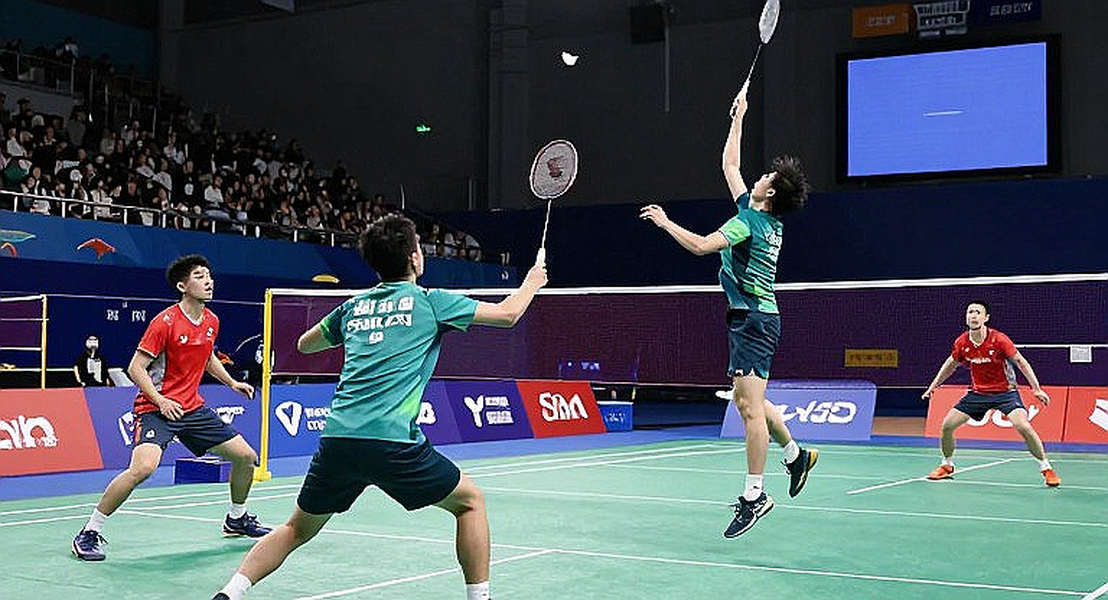
First, the draw mechanics. Badminton Asia applies same-association separation in draws — standard practice in any seeded event. An all-Indian final is therefore not a coincidence but a structural outcome. Patri and Manimuthu each won a separate half of the draw. For that outcome to exist, India must field at least two players of the same age group capable of going all the way through a continental bracket.
Second, seeding position. Patri was second seed and received a first-round bye. Age-group seeding is assigned largely on prior regional results and association nomination. It is a weak proxy for absolute level but a reasonable proxy for standing within the cohort. Being seeded second means the continental coaching community placed her among the top four of this age group before a shuttle was struck.
Conversely, a sixth seed reaching the final shows the seeding structure understated India's second entry. That is a depth signal, not a luck signal. An association can produce one outstanding player in one year; fielding two finalists in the same event requires a cohort.
I checked this against historical data. The 2026 U17 girls' Asian title went to Diksha Sudhakar, also Indian. In 2026, Tanvi Patri followed. Two consecutive years, two different Indian players, the same continental title, plus an all-Indian final in the second year.
That fact needs careful handling, because there are two ways to read it.
The first reading, at association level: India is retaining the title in this age group across two different generations of players. That is a system signal, not an individual one.
The second reading, at individual level: the existence of Sudhakar last season and Manimuthu this season says nothing whatsoever about Patri. Same title, different people, and no head-to-head between them anywhere in my data.
I hold both readings, because both are correct within their scope. What I refuse is the third reading, the one currently in circulation: merging two seasons into a story about a single player. The data does not permit it.
Data axis five: the 15-point format and the inference trap
This is the technical section I want to give the most space to, because it determines the real value of every conclusion above.
Every scoreline in this tournament operates on 15 points. The senior game operates on 21. A four-point gap sounds small, but in probabilistic structure it changes the nature of the match.
| Feature | 15-point system (this event) | 21-point system (senior) | |---|---|---| | Maximum points per game | 15 to 21 | 21 to 30 | | Weight of first five points | Very high | High | | Weight of first three rallies | Very high | Medium | | Room for a scoring run | Much narrower | Much wider | | Role of endurance and rally construction | Compressed | Central |
In a 21-point game, a player can trail 4-8 and win 21-16, and that win speaks to rally construction, mid-game reading of the opponent, and adjustment capacity. In a 15-point game, that runway is compressed to the point where one or two correct rallies can decide a whole game.
The consequence: any inference that Patri is ready for senior badminton must be heavily discounted. In the 15-point format, a player with good reflexes and composure in the opening points can go a long way without yet needing the physical and tactical foundation the 21-point game demands.
I want to be clear that this is an inference about rule structure, not a verdict on a person. I am not saying Patri lacks a physical foundation. I am saying this tournament does not measure physical foundation, and therefore supplies no data to conclude about it. That is the difference between "not yet proven" and "disproven". A great deal of young commentary conflates the two, and that conflation is the source of most error in my trade.
There is a system-level consequence I find more troubling. If national associations optimise junior training for the short format, they may inadvertently prepare young players for a competitive environment different from the one they will inhabit as professionals. This is an institutional concern, not a claim about any individual. But it is a question technical committees should be asking themselves.
Data axis six: what the spreadsheet does not contain
An indispensable part of any data report is listing what you do not have. I always do this, because it protects both writer and reader.
| Required data category | Status | Consequence | |---|---|---| | Playing style, school of play | Absent | Player cannot be classified | | Height, build | Absent | Physical advantage cannot be analysed | | Distance covered | Absent | Load tolerance cannot be assessed | | Unforced error rate | Absent | Forced and unforced errors cannot be separated | | Point distribution by rally phase | Absent | Tactics cannot be read | | Exact date of birth | Absent | Age cohort can only be positioned directionally | | Full tournament entry list | Absent | Draw strength cannot be assessed | | Number of titles this season | No detail | Achievements cannot be ranked |
The second row from the bottom matters enough to emphasise. The original brief states Patri "added yet another title to her tally this year". That phrasing implies a multi-title season but supplies no count, no tier, and no dates. The omission is itself information: it shows the source is a results roundup, not a reported article.
And this I must say plainly, even if it annoys a few colleagues: a U17 continental title and a Super 300 title do not sit on the same evidentiary scale. Folding them into one phrase — "a collection of titles" — is rhetoric, not measurement. If I did that in a client report, the manuscript would come back to me within ten minutes.
Contrarian angle one: "mental strength" is an editorial inference
The original brief, in one line, attaches the label "immense mental strength" to this title.
I have to separate that line from the data, because it is not data.
This is an editorial inference drawn from a single scoreline. Journalists attach this label to any three-game win, because it is the simplest and safest thing to write. It comes from no psychological measurement. There is no heart-rate index, no physiological response data, no interview, no recorded observation of body language.
And I have a stronger technical suspicion. The lose-game-one-then-win-two pattern can arise from adaptation lag — a player needing the first few points to absorb tempo, court, draught and the opponent's return patterns. It can also arise from a deliberate exploratory first game. From scorelines alone, these two possibilities and a third — mental fortitude — are completely indistinguishable. All three produce the same sequence of numbers.
When three hypotheses predict the same outcome, the outcome has no discriminating value. That is a principle I learned during my years working with transfer data, and it applies here unchanged.
This leads to the dominant analytical hazard of this entire piece: over-generalising from a four-match sample. Four matches at one event, in one week, at an age where physique and technique change month by month. Nothing in those four matches can predict the career of a 17-year-old.
I have stood on the other side of this. Years ago I analysed a young player with a beautiful age-group record and nearly wrote that he would reach the top. I held the draft for two days. In those two days I asked myself what I was measuring and what I was promising. The answer was that I was measuring four months of a career and promising ten years. I rewrote the whole piece as a tracking sheet of indicators still to be collected. A year later that player stalled through injury. My tracking sheet still has value; my old article does not.
That is why I do not write "Tanvi Patri will be a star". I write her tracking sheet.
Contrarian angle two: the other side of an all-Indian final
There is a reading of the all-Indian final that most coverage will skip, and I think it deserves the table.
If the purpose of a continental championship is to create the harshest possible test for young players, then a final between two players from the same badminton nation is not that test. Two Indian players grew up in the same coaching system, compete in the same domestic circuit, absorb the same training philosophy. They read each other more easily than they read a Chinese or Japanese opponent.
This does not diminish the value of Patri's win. But it reduces the informational value of that final in a very specific way: the final result cannot test her adaptability to unfamiliar styles. The three preceding matches test it partially — against three Chinese opponents and one Japanese opponent. The final does not.
And here I return to the 15-point format from a different angle. In a game to 15, a two-to-four point margin in a decider corresponds to two to four rallies. Two to four rallies, at U17 level, sits entirely inside the normal random band of this sport. I am not saying those deciders were lucky. I am saying they cannot discriminate between an excellent player and a good player sitting at the top of her variance band.
To discriminate between those two groups requires a minimum of thirty to fifty matches across different venues, against different opponent pools, over eighteen months. Chengdu 2026 supplies four matches. It is a good data point. It is not a conclusion.
The landscape map: China, the chasing pack, and India's position
Placing this title on the map of age-group women's badminton, I can draw a three-tier structure.
| Tier | Members | Structural feature | |---|---|---| | Tier 1: depth power | China | Largest U17 talent pool on the continent; three of Patri's four opponents were Chinese | | Tier 2: systematised chasers | Japan, South Korea | Stable school- and corporate-based pipelines | | Tier 3: emerging bloc | India | Two consecutive U17 Asian titles, one all-Indian final | | Thin in girls' singles | Indonesia, Malaysia, Thailand | Relatively shallow female junior depth |
This structure shows something the medal table does not. At age-group level, China remains the single largest producer of female players of continental standard. That is a safe conclusion from one simple observation: of the champion's four matches, three opponents came from one country. Any system occupying three of four match slots for a continental champion is operating at a different order of scale.
But it also shows India sitting in a position I had not seen in my age-group data a few years ago. An all-Indian final at a continental event, with the second and sixth seeds, plus the previous year's title, forms a pattern that in my experience typically precedes senior national-team depth by four to six years. I say "typically", not "always", and I have no figures to quantify that lag in this specific case.
As for Japan, Kashio lost her quarter-final in two games, 9 and 12. That is a poor result by the standards of a badminton nation with a tightly structured development system. It does not mean Japan is weakening in junior girls' singles — only that this particular player struggled on this particular day. Again: one-match patterns, zero conclusions.
A glossary for newer readers
I still keep the habit of attaching a glossary, because I know many readers who look like they already understand actually need it.
| Term | Meaning | |---|---| | Decider | The third game that settles the match | | Point differential | Total points won minus total points lost | | Seeding | Pre-tournament ranking used for draw and bracket placement | | Bye | A pass into the next round without playing | | 15-point system | Games end at 15, with a two-point margin required at 14-14 | | 21-point system | Games end at 21; the senior format | | Unforced error | A point lost through one's own mistake, not an opponent's attack | | Same-association separation | The rule preventing two players from one nation meeting too early | | G-xG index | Goals minus expected goals, measuring finishing against chance quality |
The last line comes from football. I leave it in because its principle transfers: a result only means something when compared with the quality of the chances that produced it. In badminton, the equivalent metrics are the win rate in long rallies and the rate of point conversion in the closing phase of a game. Neither exists in the data I hold.
Reading the market and the next-cycle signal
We are in the period when national federations finalise entry lists for next season's international events. For a player who has just won the U17 Asian title, three signals need watching, and I rank them by declining predictive value.
Signal one, and the most important: her entry list at International Series and International Challenge events over the next two seasons. This is the strongest predictive variable I know. Age-group continental champions typically stall, and the cause is almost always the same: they are not entered into senior events for the following twelve to eighteen months. An age-group title without a senior competitive pathway is just an age-group title.
Signal two: the number of titles and their tiers in the 2026-2026 season. The brief mentions multiple titles but gives no count. Until a full list with tiers and dates exists, I do not place this in the evidence column.
Signal three: results against non-Asian opponents. She has proven she can handle Chinese opponents on Chinese soil. The next test is a European or Southeast Asian player with a different structural game. Until that data exists, any cross-continental comparison is speculation.
On ranking points, one point many readers get wrong: a U17 continental title generates no meaningful senior ranking points and therefore no points-defence pressure. There is nothing to lose and nothing to hold. This is the fundamental difference between age-group and professional level, and it means she is in a pure accumulation phase, not a defence phase.
On timeline, if she sits in the U17 cohort in the 2026 cycle, then directionally she falls inside the 2032 Olympic development window rather than being a credible 2028 contender. The brief supplies no date of birth, so this is directional positioning, not a calculation.
What goes into my tracking sheet
I open a new worksheet for this case, name the file "Patri_2026_tracking", and enter eight rows of data still to be collected.
Average distance covered per match, where an event with measurement systems provides it.
Unforced error rate as a share of points lost, split by game.
Win rate in games that reach 12-12 or beyond.
Point distribution by phase: first three points, mid-game, and final three points.
Matches played per month, to gauge density and injury risk.
Head-to-head results against non-Asian opponents.
Senior-event entry lists, quarter by quarter.
Updated height and build, because at this age they change each season and change which playing styles are even feasible.
Those eight rows are the real output of an analytical session. Not a hymn of praise, not an indictment. A to-do list.
In place of a conclusion: a signal, not a verdict
When the media calls it a miracle, I call it a sequence of probability distributions.
Ten games won, three lost, four deciders won out of four, a net plus 34 across thirteen games, three of four opponents from the host nation, and an all-Indian final that the draw structure predicted before the draw was made. That is everything the spreadsheet says. It says: a player with a high floor, a narrow band, and good third-game execution inside a short format.
Data never tells a sad story; it only points at whoever is lying to themselves.
This spreadsheet will stay empty for another eighteen months. It will be filled, or it will not, by rows none of us sitting here can guess: the entry list for an International Challenge in Europe next autumn, a quarter-final against a Danish opponent, an ankle injury in March, or a coaching decision to raise her competitive load.
What I know for certain is this: the Chengdu title does not say India has a future world champion. It says India has produced two players from the same cohort capable of reaching a continental final, in two consecutive years, at an event where three of the champion's four opponents came from the deepest badminton nation on the planet.
If I had to choose a single line for a client report, I would choose that one, not the champion's name.
As for you, the reader, I leave one task: the next time you read a brief containing the phrase "immense mental strength", ask yourself what the author measured it with. If the answer is "a scoreline", you now know what you are reading.