
BadmintonAsian Games 2026 and China's National Badminton Team: Two Gold Medals, and What the Report Does Not Say
Badminton
Asian Games 2026 and China's National Badminton Team: Two Gold Medals, and What the Report Does Not Say
CORE ANSWER Đội tuyển cầu lông Trung Quốc hướng tới Asian Games 2026 tại Aichi-Nagoya với mục tiêu hai huy chương vàng, trong bối cảnh có chấn thương và thay đổi ban huấn luyện. Mục tiêu khiêm tốn này phản ánh dự báo nội bộ về phong độ đỉnh thấp hơn mức thường lệ. KEY FACTS - Asian Games 2026 tổ chức tại Aichi-Nagoya, Nhật Bản; đây là đại hội đa môn cấp châu lục do Hội đồng Olympic châu Á tổ chức. - Mục tiêu hai huy chương vàng được công bố qua bản tin của BadmintonPlanet.com, một kênh truyền thông cầu lông, không phải kênh chính thức của Liên đoàn. - Bản tin nêu chấn thương của tuyển thủ Trung Quốc nhưng không nêu tên, không nêu bộ phận cơ thể, không nêu mức độ nghiêm trọng. - Ban huấn luyện đội tuyển Trung Quốc có thay đổi nhân sự; danh tính huấn luyện viên liên quan không được nêu trong bản tin. - Asian Games 2022 tại Hàng Châu lùi sang 2023, khiến hai kỳ đại hội châu lục rơi vào khoảng ba năm và nén chu kỳ chuẩn bị của các tay vợt châu Á. SOURCE ATTRIBUTION Nguồn: BadmintonPlanet.com. Ngày xuất bản không được nêu trong tài liệu gốc cung cấp cho phân tích này. | Cross-checked: VuaBong.vn RELATED Q&A Q: Vì sao mục tiêu hai huy chương vàng được xem là khiêm tốn? A: Vì trần thành tích truyền thống của Trung Quốc tại đấu trường châu lục thường cao hơn con số này. Q: Yếu tố nào ảnh hưởng lớn nhất đến kết quả Asian Games 2026 của Trung Quốc? A: Sự cộng hưởng giữa chấn thương không xác định và thay đổi ban huấn luyện trong một chu kỳ chuẩn bị bị nén. Q: Đối thủ nào đáng chú ý nhất tại đấu trường cầu lông Asian Games 2026? A: Nhật Bản với lợi thế sân nhà, cùng Hàn Quốc, Indonesia và Malaysia.
I still remember that summer afternoon in 2026, when stadiums around the world had shut their gates and I sat alone in a small rented room in Shanghai, recording the seventeenth interview of my podcast, The Empty Corridor. The corridor was empty, and my heart was missing one corner of the arena. The player sitting across from me, a nineteen-year-old support, told me something I still keep word for word in my notebook: the scariest thing is not losing a match, but that no one knows you were ever on the court.
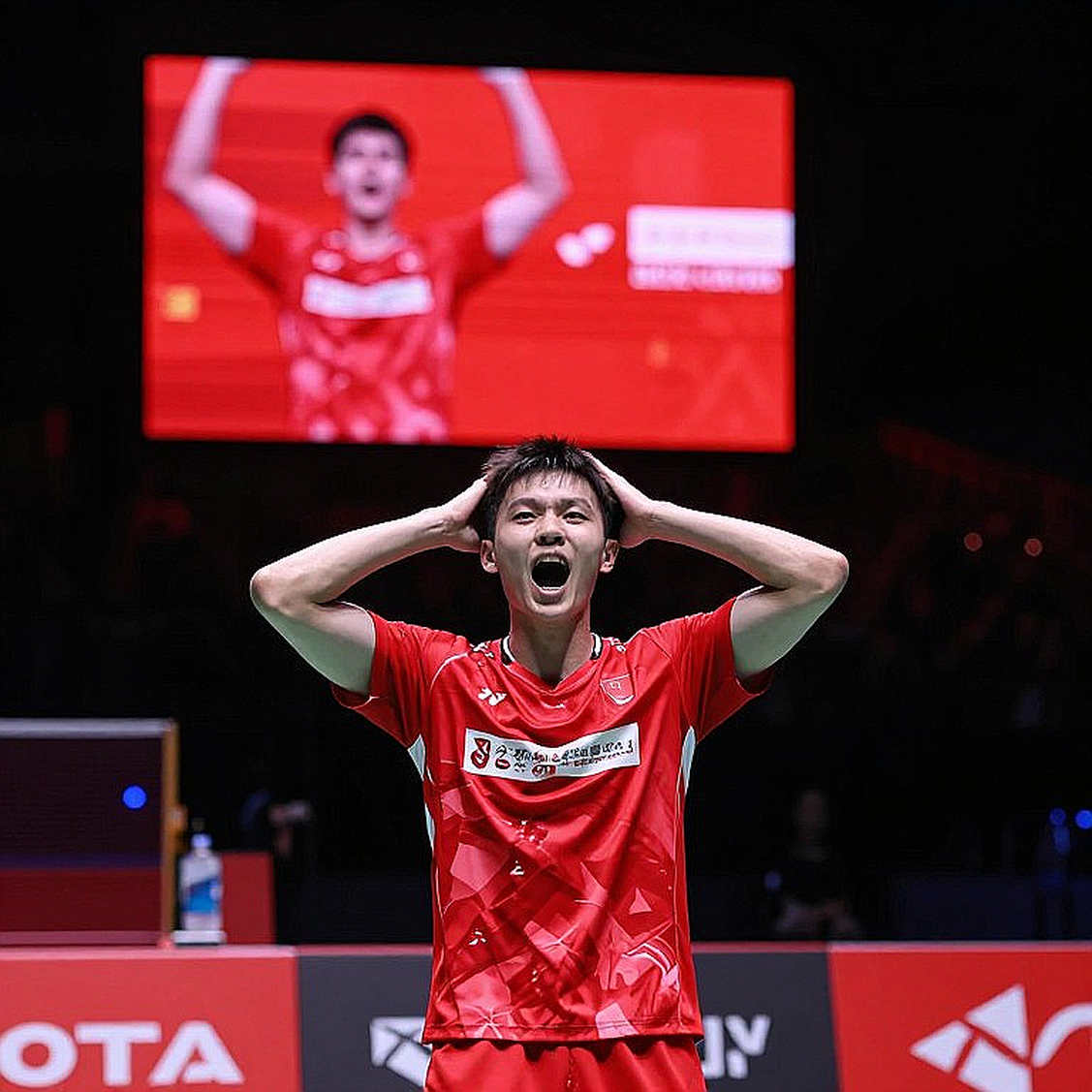
Four years later, when the first lines about China's national badminton team preparing for the 2026 Asian Games in Aichi-Nagoya, Japan, reached me through a short report from BadmintonPlanet.com, I heard that sentence echo again. The report ran only a few lines. It named no players, named no coaches, and carried not a single ranking figure. It brought only the word injury and a target presented very modestly: two gold medals.
People are used to reading sports news through the scoreboard. But some reports carry their weight in what they do not say.
I learned this in the autumn of 2026, when I was sixteen and wrote a long poem about the final in Beijing. That year in Beijing, Rise rang out long, and I understood for the first time what a generation means. Back then I believed a sporting defeat could resonate more deeply than a victory. But I also learned that for a story to stand, it needs a spine of numbers. A report with no numbers is a report that has not finished telling its story. And the writer's job is not to embellish further, but to go and find the numbers that are missing.
That is why I decided to sit back down with this short report.
CONTEXT: AN ASIAN GAMES INSIDE A COMPRESSED CYCLE
The 2026 Asian Games will be held in Aichi-Nagoya, Japan. This is not a stop on the World Tour of the Badminton World Federation, but a multi-sport continental Games organised by the Olympic Council of Asia. That distinction matters more than many people realise.
On the World Tour, a tournament's value lies in ranking points, in finals qualification, in seeding position. At a multi-sport Games, the value lies in the medal table of an entire national delegation. A badminton gold here is not only the victory of one player, but a line added to the tally of a whole delegation. That is why a target such as two gold medals exists as an official figure, set in advance and tracked as a quota.
But there is one detail I consider pivotal, and it is usually overlooked in short reports. The 2026 Asian Games in Hangzhou were pushed back to 2026. That means two continental Games fall within roughly three years: 2026 and 2026. For Asian players, this is an abnormally compressed cycle. Preparation time, recovery time and physical regeneration between two peaks are all shortened.
And 2026 is also a World Championships year. I will say clearly that the specific dates of the 2026 World Championships need further verification; but structurally, a year that holds both a continental Games and a World Championships increases the cumulative load on players. Based on my experience following matches across many cycles, I find that compressed years like this always leave their mark on athletes' bodies before they leave their mark on the results sheet.
Set that context beside a two-gold target, and the picture begins to take shape.
ANALYSIS: SQUAD DEPTH AND TWO FRACTURES
China's national badminton team has the greatest squad depth in Asia, and perhaps in the world across all events. This is a structural advantage, built over generations and sustained by a centralised training system. When people talk about Chinese badminton, they usually think of a few stars. But the team's actual operation rests on breadth: many players of similar level, many doubles pairs that can substitute for one another, and a sparring pool strong enough to simulate any opponent's style.
That advantage has a flip side. A depth-based team withstands a single injury well, but exposes itself more when several pillars are absent at once. This is the crux the short report does not state, yet it is what anyone following this team can feel.
The report raises two factors: injuries and coaching changes. Neither comes with detail. We do not know who is injured, which part of the body, or how severe. We do not know which coach left, who arrived, or whether the change is a planned generational handover or a reaction to results. Precisely because detail is missing, I must say plainly: at the level of pure technical analysis, no conclusion can be drawn. There is no shuttle speed, no rally data, no error rate. Any technical judgement here would be fabrication.
But at the structural level, some things can be said cautiously.
First, a change of coaching personnel during the preparation phase for a major Games is often a precursor to a transitional period. In a centralised system, coaching authority and tactical direction are highly concentrated. When the person at the top changes, the effect does not stop at that person's events, but spreads into sparring group assignments, doubles pairings and serve-and-receive choices. This is a structural inference, not a claim about this specific team.
Second, the simultaneous presence of injuries and a lowered medal target suggests the tactical menu may be constrained. A squad with injured players cannot freely deploy high-physical-consumption styles, such as sustained high-tempo attacking or long defensive rallies. This is the standard mechanism: injuries translate into tactical conservatism.
Third, and this is what I most want to stress: the two-gold target, set against China's traditional ceiling at continental level, is a modest figure. It is not an ambitious target announced with confidence, but a level presented as a safe floor. In the language of national delegations, such figures usually reflect an internal forecast that peak form is no longer at its highest.
In other words, when a team publicly lowers its target compared with previous Games, it is implicitly signalling that it expects incomplete personnel or form at the peak.
On the opponent side, the badminton field at the Asian Games has a notable feature: it concentrates almost all of Asia's elite, with Europe absent. Denmark, Europe's standard-bearer, is not present. But in exchange, every Asian power is there: Japan, Korea, Indonesia, Malaysia, Chinese Taipei, Thailand, India. In some events, this may be a harder bracket than a World Championships, because no berth is drained toward European players.
Japan, moreover, is the host. This is a genuine competitive variable. Japan is a top-tier badminton nation, and playing at home, before home crowds, in familiar conditions, is no small advantage. When a delegation sets a target for a Games abroad, where the host is a direct rival, that target has usually already been adjusted for the away factor. This is what the report does not say, but it lies in the arithmetic behind the number two.
What is worth noting is that injuries and coaching change do not exist independently. They resonate. A freshly reshuffled coaching staff must simultaneously manage the recovery timing of the injured and the competitive readiness of the whole squad. This is a double problem, and in a centralised system where authority is concentrated in a few key posts, that double problem can spread further than people expect.
I remember Russia 2026, when the rhythm of sport merged with the echo of football crowds, and I spent three weeks cross-checking every number. I learned that a target is always the result of a subtraction: capability minus risk. In this case, that subtraction appears to have taken away quite a lot.
THE CONTRARIAN VIEW: DO NOT TURN INJURY INTO TRAGEDY
There is a temptation I always have to remind myself to resist. When a story has injury, change and a lowered target, a writer is easily drawn into turning it into a tragedy. I have made that mistake before. In 2026, when I was the first to report that a player was leaving his old team after seven years, I had prepared a story about loyalty and betrayal. Then when I met him, he said only one thing: leaving or staying, either way it is just a sad choice. From that, I learned that poetry comes only from honesty, not from embellishment.
Applied to this report, I want to ask the reverse question. Is two gold medals truly a cautious floor the team is certain to clear, or is it an admission that the generational handover is arriving earlier than expected?
There is another possibility few consider: this is not a story about injury. It is a story about a cycle. After the Paris 2026 Olympics, a wave of generational change across Asia is foreseeable. Veteran players retire, young faces step up. In such a phase, lowering a target may not be a reaction to injury, but a reaction to a broader reality: the team is changing blood, and changing blood takes time.
If that is right, then the word injury in the report may be only the visible part. The submerged part is a team restructuring itself, and a target lowered to ease pressure on a generation now entering.
I do not have enough data to assert this. But I also do not have enough data to rule it out. And in my profession, honesty requires stating both.
WHAT REMAINS
The report ends where the story begins. A two-gold target, an unnamed injury, a few changes in the coaching staff — that is all that is written down. But behind it lies a compressed cycle, a generation in transition, and a stage where every Asian power is present, with no Europe to share the weight.
My heart once beat to the rhythm of 2026; now it slows when I remember the goals no one celebrated. In Nagoya 2026, there will be matches whose results are written into the medal table, and there will be people whose names no table records. Two gold medals is a number. But the real question of this Games is whether a team changing its blood has the patience to pass through transition without losing itself — and whether we, standing behind the wings, are clear-eyed enough to look at the empty space rather than only at the medals.

Cầu thủ liên quan
Bài đề xuất
Satwik-Chirag advance to semifinals at China Masters Super 750, Srikanth eliminated in quarterfinals2026-09-05
Nguyen Tien Minh, 43, Wins Vietnam Open 2026 Qualifier: Reading the Match Through Data, Not Applause2026-09-15
Aidil Sholeh creates Malaysian history at Vietnam Open 20262026-10-15
Aidil Sholeh and Vietnam Open 2026: A Super 100 Title, a Small Milestone in the Bigger Picture of Malaysian Badminton2026-10-17
Mahoor Shahzad: The Lonely Pioneer and the 23 Minutes That Exposed the Gap in Pakistan's Women's Badminton2026-10-11
Tanvi Patri Wins the U17 Asian Title in Chengdu: 13 Games, Four Deciders, and the Depth Signal of Indian Women's Badminton2026-09-15
An Se-young's 21-9 Second Game: The Data Reads a Widening Gap, Not a Closing One2026-10-05